my Trade Tripper column in the 19-20 February 2016 issue of BusinessWorld:
(This article was co-written with Atty. Cristina Montes, LLM Navarre, a specialist on globalization and constitutional issues, and cofounder of the Philippine Principles Institute)
That the Philippine legal system is substantially founded on natural law -- an objective standard of right and wrong based on a correct understanding of human nature and discoverable by reason, transcending positive laws and to which the latter must conform -- should be uncontroversial. Many important events in world history, such as the movements against slavery and racial segregation in the United States and the prosecution of war criminals at Nuremberg, depended on it.
In fact, the seeming local unfamiliarity with natural law is ironic considering our strong affinity to the Bill of Rights. These rights (e.g., to life, liberty, and property, etc.) exist independent of the Constitution precisely because such are considered inalienable and inherent (“natural”) to man.
One can clearly discern natural law clearly in our history, with figures such as Jose Rizal and Apolinario Mabini intellectually relying on the same: the former recommending natural law be taught to “form and educate young men of good family”; the latter believing that determining good and evil is done through one’s conscience and man’s ability to reason.
However, since natural law theory is given a superficial treatment in law schools -- if ever it is taught at all -- many lawyers either reject the natural law theory on mistaken beliefs about it, or apply it erroneously.
For example, many criticize natural law theory on the belief that it is a theological or philosophical notion that has (or should not have) any bearing at all on society, or that it is a Catholic notion that has no place in a pluralistic society.
The first position is absurd as it assumes that laws do not have any philosophical foundation whatsoever. And contradictory as well because to posit that laws have no philosophical foundations is itself a philosophical foundation.
As for the second position, while it is true that the influence of the Enlightenment and the Judeo-Christian philosophy in our Constitution is undeniable, it’s wrong to assume that only Catholics are capable of arriving at a notion of a universal human nature or immutable human rights.
The Judeo-Christian philosophical structure is heavily reliant on reason (rather than mere Scriptural or “revealed truths”) and such reason itself is available to all regardless of one’s faith.
There is also the diversity of natural law thinkers throughout history, including pre-Christian Greeks and Romans like Sophocles, Aristotle, and Cicero; some Islamic scholars like the Mutazilites; and Protestants like Hugo Grotius, among many others.
Another criticism of natural law theory is that it breeds instability by encouraging judges to resort to extra-legal criteria in deciding cases.
Unfortunately, this criticism is not totally unfounded as the notion of natural law has been abused by those citing it as an excuse to deviate from the law or even the Constitution to suit a particular agenda.
One example would be those who espouse the “living Constitution” theory, or the notion that the Constitution is fluid and can be given any interpretation -- no matter how obviously strained -- in order to accommodate any government action that clashes with the literal meaning of the Constitution.
Another example would be those who advocate deviating from the literal text of the law out of pity for a class deemed to be deserving of pity -- such as foundlings with presidential ambitions.
These abuses of natural law arise not from the notion of natural law, correctly understood, but from misunderstandings of what natural law is.
Such misunderstandings forget that while natural law transcends positive law, it is also objective. It is based on universal human nature, not on the whims of whoever is in power. They also mistakenly assume that the essence of natural law is in being opposed to positive law.
It is true that natural law is usually invoked in opposition to positive law where the positive law that applies to a given situation is unclear, or where a strict application of the positive law will yield an absurd or patently unjust result that will defeat the purpose behind the legal provision in question.
But in general, natural law theory itself demands obedience to legitimate human authority as a necessary element of the common good. Natural law also grants authorities the flexibility to enact measures that, though not essential to achieving human flourishing, are necessary to pursue inherent human goods. An example of such would be traffic rules.
Disseminating more information about natural law theory is an immediate solution to such misunderstandings. But truer remedies lie deeper.
We must rid ourselves of preconceived liberal prejudices and instead assign value and reward efforts to learning correctly about human nature, of truth, and objective moral standards. Otherwise, laws -- and the words that make up those laws -- will not mean anything.
Esoteric as these issues may seem, how we respond to them will profoundly impact our society
12.3.16
When law schools go left
my Trade Tripper column in the 12-13 February 2016 issue of BusinessWorld:
In the US, indubitably true. There, it is quite a given that whether the school be Yale or Harvard or Georgetown the chances that the faculty (and its students) will tilt to the left of the ideological spectrum is stratospheric. A well-known 2005 study by John O. McGinnis, Matthew Schwartz, and Benjamin Tisdell found that 94% of Stanford Law’s faculty contributed to Democratic candidates. This one-sidedness is hugely disconcerting.

At the “elite” level, the same could probably (arguably) be said of Philippine law schools. At least undeniable is that the portion of the Philippine legal community deeming themselves as secular “progressives” or “radical” activists is unabashedly noisier.
The problem with the unchecked dominance of leftist or progressive law schools (or even simply law faculties overrun by progressives) is profoundly significant:
“The best way to get to truth is through the clash of zealous advocates on both sides. All of these law professors have, in theory, dedicated their lives to the study of this axiomatically adversarial system. And yet, at most of these schools, on most of the important issues of the day, one side of the debate is dramatically underrepresented, or not represented at all. One result, unfortunately, is a certain lack of rigor. To be blunt, a kind of intellectual laziness can set in when everyone agrees.” (Nicholas Quinn Rosenkranz, “Intellectual Diversity In The Legal Academy,” 2013).
This similarity of thought, the bland uniformity, veering towards the secular progressive mind-set does not bode well for the Philippine legal profession: an expression of a contrary opinion (like supporting traditional families, that gender differences are not social constructs, or that citizenship matters) would be met by apoplectic reactions resembling epileptic seizures. This is not legal education. It’s leftist indoctrination.
And this “indoctrination” permeates throughout society: to the clients advised, the politicians elected, judges deciding between parties, to the media that interview or seeks lawyer’s opinions on matters of national importance, and the people who listen or read them.
Unfortunately, as Rosenkranz (a Georgetown law professor, cheerfully identifying himself as only 1 out of 3 conservatives in a faculty of 120) observes: “this intellectual homogeneity impairs analysis of law in progress -- law as it unfolds out in the world.”
Or stated another way, as a Washington Times report (“The academy’s war on free thinking”; 2013) puts it “Unfortunately, a foundational tenet of legal education [understanding competing arguments and concepts] is not realized in the nation’s leading law schools, including Harvard, where students learn a narrowly progressive view of the law from a predominantly leftist faculty.”
One significant aspect of what is essentially “groupthink” among law faculties is that it encourages disrespect for the rule of law just to achieve a policy or ideological objective (oftentimes disguised under the “narrative” of “social justice”).
This unfortunately leads a society to chaos: an Executive branch that thinks nothing except to persecute its enemies, a Legislative branch that cowardly bows before the presidency, a Judicial branch that believes itself wiser than the other two branches (including the people themselves) and thinking itself entitled to legislate for everyone.
A bright spot: UA&P’s School of Law and Governance’s attempt to fuse liberal education with law, offering competing thoughts for the students to work out on their own: between positivism and natural law, the “originalist” thinking and the “living constitution” theory (which really needs further scrutiny), and so on.
But more needs to be done.
No law student anywhere should be marginalized for thinking differently. Or taught to resort to ad hominem arguments in discussions pertaining to law and morality, pluralism and religious rights. The important thing is that the students think rigorously and think on their own.
Finally, there is this: I participated last year in another university’s student job fair. Invited, aside from myself, were lawyers from various other law schools, there to discuss the merits of their own institutions.
The representative from a top (some would say the best) law school was a young, confident, well-dressed, female lawyer who talked in grim terms how difficultly Darwinian law school is. Classmates intensely competing against each other. Their teachers constantly (if contradictorily) telling them to have compassion for the weak but demanding they leave law school if they themselves are “weak.” All this told with F-bombs in every sentence. Perhaps to appear edgy. Also because, so she says, that’s how it was in her profanity-laden classes. I felt sad for her.
And I guess this is where the problem ultimately lies.
Law is about relationships: between individuals and between individuals and the State. Ultimately, law is about people.
If our law classrooms do not respect human dignity, from the womb and until death (or even beyond), in fact teaching there is no such thing as truth and that everything is relative, instructing students to label ideas they disagree with as medieval, then what kind of lawyers are we unleashing on society?
We all deserve better than that.
In the US, indubitably true. There, it is quite a given that whether the school be Yale or Harvard or Georgetown the chances that the faculty (and its students) will tilt to the left of the ideological spectrum is stratospheric. A well-known 2005 study by John O. McGinnis, Matthew Schwartz, and Benjamin Tisdell found that 94% of Stanford Law’s faculty contributed to Democratic candidates. This one-sidedness is hugely disconcerting.
At the “elite” level, the same could probably (arguably) be said of Philippine law schools. At least undeniable is that the portion of the Philippine legal community deeming themselves as secular “progressives” or “radical” activists is unabashedly noisier.
The problem with the unchecked dominance of leftist or progressive law schools (or even simply law faculties overrun by progressives) is profoundly significant:
“The best way to get to truth is through the clash of zealous advocates on both sides. All of these law professors have, in theory, dedicated their lives to the study of this axiomatically adversarial system. And yet, at most of these schools, on most of the important issues of the day, one side of the debate is dramatically underrepresented, or not represented at all. One result, unfortunately, is a certain lack of rigor. To be blunt, a kind of intellectual laziness can set in when everyone agrees.” (Nicholas Quinn Rosenkranz, “Intellectual Diversity In The Legal Academy,” 2013).
This similarity of thought, the bland uniformity, veering towards the secular progressive mind-set does not bode well for the Philippine legal profession: an expression of a contrary opinion (like supporting traditional families, that gender differences are not social constructs, or that citizenship matters) would be met by apoplectic reactions resembling epileptic seizures. This is not legal education. It’s leftist indoctrination.
And this “indoctrination” permeates throughout society: to the clients advised, the politicians elected, judges deciding between parties, to the media that interview or seeks lawyer’s opinions on matters of national importance, and the people who listen or read them.
Unfortunately, as Rosenkranz (a Georgetown law professor, cheerfully identifying himself as only 1 out of 3 conservatives in a faculty of 120) observes: “this intellectual homogeneity impairs analysis of law in progress -- law as it unfolds out in the world.”
Or stated another way, as a Washington Times report (“The academy’s war on free thinking”; 2013) puts it “Unfortunately, a foundational tenet of legal education [understanding competing arguments and concepts] is not realized in the nation’s leading law schools, including Harvard, where students learn a narrowly progressive view of the law from a predominantly leftist faculty.”
One significant aspect of what is essentially “groupthink” among law faculties is that it encourages disrespect for the rule of law just to achieve a policy or ideological objective (oftentimes disguised under the “narrative” of “social justice”).
This unfortunately leads a society to chaos: an Executive branch that thinks nothing except to persecute its enemies, a Legislative branch that cowardly bows before the presidency, a Judicial branch that believes itself wiser than the other two branches (including the people themselves) and thinking itself entitled to legislate for everyone.
A bright spot: UA&P’s School of Law and Governance’s attempt to fuse liberal education with law, offering competing thoughts for the students to work out on their own: between positivism and natural law, the “originalist” thinking and the “living constitution” theory (which really needs further scrutiny), and so on.
But more needs to be done.
No law student anywhere should be marginalized for thinking differently. Or taught to resort to ad hominem arguments in discussions pertaining to law and morality, pluralism and religious rights. The important thing is that the students think rigorously and think on their own.
Finally, there is this: I participated last year in another university’s student job fair. Invited, aside from myself, were lawyers from various other law schools, there to discuss the merits of their own institutions.
The representative from a top (some would say the best) law school was a young, confident, well-dressed, female lawyer who talked in grim terms how difficultly Darwinian law school is. Classmates intensely competing against each other. Their teachers constantly (if contradictorily) telling them to have compassion for the weak but demanding they leave law school if they themselves are “weak.” All this told with F-bombs in every sentence. Perhaps to appear edgy. Also because, so she says, that’s how it was in her profanity-laden classes. I felt sad for her.
And I guess this is where the problem ultimately lies.
Law is about relationships: between individuals and between individuals and the State. Ultimately, law is about people.
If our law classrooms do not respect human dignity, from the womb and until death (or even beyond), in fact teaching there is no such thing as truth and that everything is relative, instructing students to label ideas they disagree with as medieval, then what kind of lawyers are we unleashing on society?
We all deserve better than that.


28.2.16
Antonin Scalia: exemplary juror for PH
Cristina Montes and I on originalism and Justice Scalia's relevance for the Philippines.
Article can be read here.
Article can be read here.
Bloomberg interview on the Philippine budget
Here's my interview with Bloomberg regarding the Philippine budget, how the military is sorely underfunded, and how the government is encouraging a self-entitlement culture.
Interview can be viewed here.
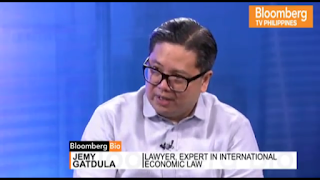
Interview can be viewed here.

15.2.16
God’s plants: SC and Bt ‘talong’ case
Cristina Montes' and me writing on the Supreme Court's contradictory legal positions:
"It's curious that the Court ignored the precautionary principle in the RH Law case when contraceptives’ threaten human life or health, as well as the environment."
"It's curious that the Court ignored the precautionary principle in the RH Law case when contraceptives’ threaten human life or health, as well as the environment."
Article can be read here.
Money can’t buy you happy
my Trade Tripper column in the 5-6 February 2016 issue of BusinessWorld:
In last week’s Republican primary debate, Marco Rubio made this interesting comment: “Why are we some of the most generous people in the world? Why do Americans contribute millions of dollars to charity? It is not because of the tax write off. It is because in this nation we are influenced by Judeo-Christian values that teach us to care for the less fortunate, to reach out to the needy, to love our neighbor.”
This very fundamental and should be obvious aspect of Senator Rubio’s statement, that the US was influenced by “Judeo-Christian” values, will be taken up in another article. Primarily because the Philippine constitutional system is quite similar to, and in fact was learned from, the US.
This column will take a break this week from constitutional or international trade issues, and take up instead more important matters: human happiness. And the effect wealth has on it. And no surprises: more money doesn’t make one truly happy.
The Philippines certainly has the lowest suicide rate in ASEAN but the number is unfortunately increasing.
In “Suicide in the Philippines: time trend analysis (1974-2005) and literature review” (Maria Theresa Redaniel, May Antonnette Lebanan-Dalida, and David Gunnella; 2011), the “incidence of suicide in males increased from 0.23 to 3.59 per 100,000 between 1984 and 2005. Similarly, rates rose from 0.12 to 1.09 per 100,000 in females.”
This must be read within the reality that the Filipino (according to the World Health Organization) is apparently the most depressed in Southeast Asia, with a reported 4.5 million Filipinos suffering from depression.
Contextually, this is interesting considering the improving economic situation (if you believe this government). And with social media, everybody can now be a celebrity in their own world, a wise political pundit, or an expert on gourmet restaurants.
And yet the sadness is there and one likely reason science tells us is self-indulgence.
Elizabeth Dunn and Michael Norton (“Don’t Indulge. Be Happy”, July 2012, New York Times) point out that: “We usually think of having more money as allowing us to buy more and more of the stuff we like for ourselves, from bigger houses to fancier cars to better wine to more finely pixilated televisions. But these typical spending tendencies -- buying more, and buying for ourselves -- are ineffective at turning money into happiness. A decade of research has demonstrated that if you insist on spending money on yourself, you should shift from buying stuff (TVs and cars) to experiences (trips and special evenings out). Our own recent research shows that in addition to buying more experiences, you’re better served in many cases by simply buying less -- and buying for others.”
Admittedly, those who say poverty is not exactly the situation that can bring out happiness are right.
But as Dunn and Norton clarifies: “People with a comfortable living standard are happier than people living in poverty. The catch is that additional income doesn’t buy us any additional happiness on a typical day once we reach that comfortable standard.”
Just accept that the new glamorous job you have, the new shiny gadget, that impressive looking car, that smart looking crowd in that sophisticated cocktail party, will just depress you, leave you feeling empty, in the long run. Because eventually, after the novelty wears off, it will all be ordinary, leaving you with yourself to contend with.
Some people’s reaction to this is to escape from the sadness by plunging into new activities, which in reality merely creates a manic circle that cannot stave off the inevitable.
“The effects of changes in people’s circumstances wear off as they get used to them -- a phenomenon economists call ‘hedonic adaptation,’” so says The Economist (reporting on the effect of wealth on people’s happiness; “Keeping up with the Karumes”; October 2015). Essentially, “We are never satisfied, since we quickly become accustomed to our own achievements.”
Admittedly, that lack of satisfaction could also spur more economic activity and the generation of further wealth. But that is beside the point because what’s the use of all that wealth if sadness becomes your constant overbearing companion?
We should encourage a society that devalues self-indulgence and immediate gratification. We must teach other the importance of thinking for the long term, of charity to others, and the strength and will to do one’s duty.
And with a Philippine demographic where 70% of the population is below 30 years of age, we really have to exert effort to ensure that the youth grow up with proper values and forego materialism, particularly the “if it feels good, do it” mentality of the 1960’s.
One good suggestion was made by Quartz’s Jenny Anderson (“Parents: let your kids fail. You’ll be doing them a favor”; October 2015) and that is to push children to stick “with tasks, even when they got frustrated,” as doing so will make them learn “focus, study, organize, and otherwise run their own lives.”
Heraclitus puts it best: character is destiny.
The day after the WTO’s tomorrow
my Trade Tripper column for the 29-30 January 2016 issue of BusinessWorld:
It’s fair to say that international trade, as well as its main institutional engine -- the World Trade Organization (WTO), is at a crossroad. Not necessarily as dramatic as existence or oblivion but quite significant all the same. The ensuing outcome ultimately would be felt more by the developing countries, particularly whether the benefits of trade could help them sooner or much much later.
Certainly, many in the developed world would be happy to see Doha dead and buried.
But some, albeit qualifiedly, still see the value of Doha’s ambition. EU commissioner for trade Cecilia Malmström, writing for Politico (“Doha may be dead. Long live free trade”, 21 January 2016):
“First, since the Doha Round was launched in 2001, the world has changed economically, politically, and as the theme of this year’s Davos conference makes clear, technologically. Second, many of the issues at the heart of the Doha talks, which aim at improved trade rules focused on development and growth, remain essential. Third, the structures of the DDA [Doha Development Agenda] have not allowed us to reach a comprehensive agreement on most of these issues. We have had all the time in the world but have not managed to do it. Fourth, the WTO is still vital. Its comparative advantage is the most favored nation principle, which means each member should treat all others the same. This allows the WTO to set rules that apply everywhere. And these rules [are] upheld by a strong dispute settlement system.”
Setting Ms. Malmström’s conditions aside, I still say developing countries, like the Philippines, would do well to keep pushing for Doha. It would allow smaller countries valuable time to gather the ability to integrate better, with less pain as possible, into the multilateral trading system. It would also be an exercise in trust that the WTO membership is not engaged in a zero-sum game.
And particularly for the Philippines, this much is true: we need to develop an overarching national vision on international trade. The same, by the way, goes for defense. Our country’s development should not be made to depend on external motivation, spurred by international agreements rather than self-initiated legislation, as our more experienced policy makers advocate. No. We must develop our own strategy, for the long haul, drawing from our unique culture, situation, and history, formulated and then implemented in our own, our Filipino way. Regardless of any grad school gibberish, foreign relations will always be an extension of a country’s domestic policy, of its beliefs and values as a people.
Thus, while this column will not profess enthusiasm for special and differential treatment (both for developing countries and least developed countries), nevertheless, the Philippines should insist that development be the underlying theme of the WTO, at least for the remainder of this decade: capacity building, transparency, and market access (including, of course, the elimination of domestic farm subsidies).
It is there where developed countries should exert their focus on, rather than antagonizing poorer countries with constant demands for stricter and binding rules on trade facilitation, competition policy, investment, intellectual property, e-commerce, and digital trade. These should wait. There should be enough policy space to instead encourage countries to unilaterally do what’s best for their specific circumstances, while solidifying any further development gain that could be achieved under Doha.
Only after Doha has been achieved should the WTO move on from it. And only then will it be proper to agree to a practical (rather than theoretical) acceptance of the fact that international trade is different now than a decade ago.
Aside from goods (and even services) no longer following the one country-selling/one country-buying model, more tellingly (as Jon Huntsman, “The Future of Global Trade”; Wall Street Journal April 2015, relates):
“Trade flows will reflect the realities of global power as well as demographics. The Pacific will no longer be the dominant trade hub. Instead, the focus will shift to the Indian Ocean region, which upward of eight billion people -- mainly in China, India, and Africa -- will call home. The US may not be in a position to influence trade the way it did. For the past 200 years, Britain, after the Industrial Revolution, and the US after the two world wars, fought for an open trading system to promote growth. None of the emerging countries have thus far shown that same commitment, even though they -- particularly China -- are increasingly setting the pace in world trade.”
In the meantime, studies should be made -- with a view to minimizing the trade distorting effects -- of domestic regulations that remain to operate beyond the pale of international trade agreements: burdensome language issues, inconsistent rules between one local government unit to another, and local corruption.
Finally, and this with the Philippines specifically in mind, the WTO should learn to assist countries get rid of smuggling. This has politically (illogical, I know) resulted in local citizenry’s distrust of international trade, as well as rendering inutile trade remedies such as anti-dumping or safeguards.
Subscribe to:
Posts (Atom)